
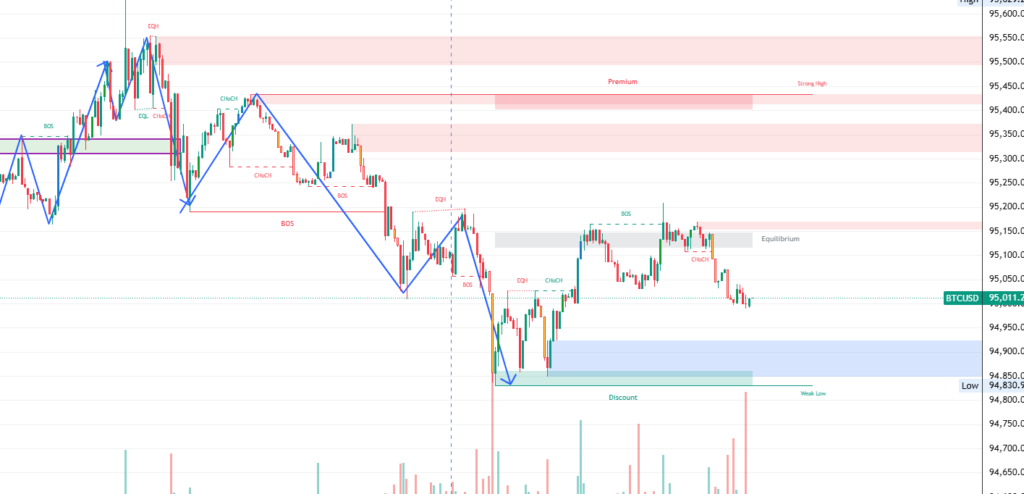
Smart Money Concepts
For decades, retail traders have believed that markets move because of patterns, indicators, or news. Yet despite thousands of tools, “strategies,” and signals, retail loses money consistently, while institutional desks, dealers, and liquidity providers profit through every cycle.
The reason is surprisingly simple:
Markets move to seek liquidity – not to validate retail indicators.
This idea forms the backbone of what traders today refer to as Smart Money Concepts.
But SMC is not a trading system. It is a microstructural explanation of how capital actually flows in financial markets.
This blog breaks down SMC in a clean, non-hyped, framework-driven way that aligns with real execution logic.
1. Markets Are Liquidity Machines
Every market has one fundamental requirement:
For every buyer, there must be a seller – and vice versa.
But buyers and sellers rarely appear evenly. Often, institutions need:
- buyers to offload their long positions (i.e., distribute)
- sellers to accumulate long positions (i.e., accumulate)
To create these counterparties, the market uses price itself as a tool to induce participation.
This is why the market will:
✔ sweep highs
✔ sweep lows
✔ trigger stops
✔ fake breakouts
✔ trap late participants
✔ reverse from extremes
Not to “confuse” traders – but to source liquidity.
2. The Retail vs Smart Money Operating Difference
Retail trades based on confirmation.
- Breakout → buy
- Breakdown → sell
- RSI oversold → buy
- RSI overbought → sell
Smart money trades based on liquidity needs.
Retail asks:
“Is this a bullish signal?”
Smart money asks:
“Where are the stops? Where is liquidity? Where will others be forced to act?”
This distinction alone explains why retail routinely buys at tops and sells at bottoms – because those are the points where max liquidity exists.
3. Key Pillars of Smart Money Concepts
Let’s break the SMC framework into its core building blocks.
(A) Market Structure
Markets transition through structural phases:
- Accumulation
- Expansion
- Distribution
- Decline
Each phase is identified through BOS (Break of Structure) events.
- Bullish BOS → continuation up
- Bearish BOS → continuation down
Structure reveals intent, not entry signals.
(B) Liquidity
Liquidity pools form at places where retail clusters orders:
- equal highs
- equal lows
- swing highs/lows
- obvious support & resistance
- breakout points
- stop-loss zones
These zones become targets, not entries.
When you see equal highs, retail sees:
“Strong resistance to short.”
Smart money sees:
“Liquidity to grab before moving lower.”
(C) Premium & Discount Pricing
From a significant swing:
- Upper half of the range = premium (sell zone)
- Lower half = discount (buy zone)
Smart money enters in discount and exits in premium – similar to how businesses operate:
Buy wholesale, sell retail.
Retail often does the opposite:
- buys at premium because it “feels bullish”
- sells at discount because it “feels bearish”
(D) Imbalance & Fair Value Gaps
Fast displacement moves create inefficiencies in the order book – areas with low two-sided liquidity.
The market later revisits these zones to:
- mitigate
- rebalance
- fill orders
Imbalance fills are execution mechanics, not magic.
(E) Mitigation & Repricing
Institutions rarely enter in a single candle.
They:
- accumulate
- push price
- return to mitigate
- expand again
This is inventory management – similar to how manufacturers manage cost basis.
4. The Stop Hunt (Sweep) Phenomenon
Before large moves, price frequently takes out:
- retail breakout entries
- support
- resistance
- swing protections
- stop losses
This generates the needed orders for institutions to enter or exit.
A typical pattern:
- Sweep the high (collect buy stops)
- Shift structure
- Sell aggressively into trapped buyers
Or the inverse:
- Sweep the low (collect sell stops)
- Shift structure bullish
- Drive price upward
This behavior is foundational because it answers:
Why does price reverse exactly after triggering stops?
The answer: That’s where liquidity resides.
5. Why Indicators Fail to Predict This Behavior
Indicators compress historical price into simple numerical expressions.
They do not account for:
- stop positioning
- execution algorithms
- volume imbalances
- dealer hedging requirements
- institutional inventory cycles
Markets aren’t math problems – they are crowded behavioral systems with asymmetric participants.
This is why two traders can look at the same RSI reading and:
- Retail: “Oversold, buy.”
- Smart money: “Swept liquidity, bullish shift, discount – now buy.”
Both see the same chart, but not the same context.
6. How Do Smart Money Traders Actually Enter?
Contrary to social media myth, smart money doesn’t just “buy order blocks.”
The correct sequence involves:
✔ liquidity sweep
✔ displacement
✔ market structure shift (ChoCH/BOS)
✔ entry inside discount
✔ exit inside premium
This sequence aligns with execution flows.
7. Will Smart Money Concepts Stop Working?
This is the most common question.
SMC will not stop working for one simple reason:
As long as markets require liquidity, liquidity theory remains intact.
The surface layer of SMC may evolve:
- Entry models change
- OB definitions refine
- Timeframes shift
But the core economic drivers:
- liquidity
- inventory
- execution
- hedging
are structural requirements of any market with counterparties.
Even in fully automated HFT markets, the logic remains –
algos hunt liquidity because liquidity is where orders can be filled.
8. Why Most Traders Still Fail Even After Learning SMC
Knowledge ≠ execution.
Most traders fail due to:
(a) Impatience → they want constant trades
(b) Impulse → they chase confirmation
(c) Misalignment → wrong session/timeframe/context
(d) Emotional bias → discomfort in buying discount
SMC requires:
- waiting
- selectivity
- context awareness
- higher timeframe logic
Most humans are not wired for that.
Conclusion: The Market Is Not Random — It Is Engineered
The market isn’t a casino.
It is a liquidity engine operating through:
- deception
- inducement
- accumulation
- distribution
Retail loses not because it is stupid, but because it participates where it feels comfortable – comfort zones are rarely profitable zones.
Smart money thrives because it participates where discomfort lives – and discomfort is where liquidity lives.